UPMC: Minimally Invasive Brain Surgery

Ranked among America's Best Hospitals 2009 U.S. News & World Report  Honor Roll

Endoscopic Endonasal Approach (EEA)

Send to a Friend
Share This Page

EEA Breakthroughs

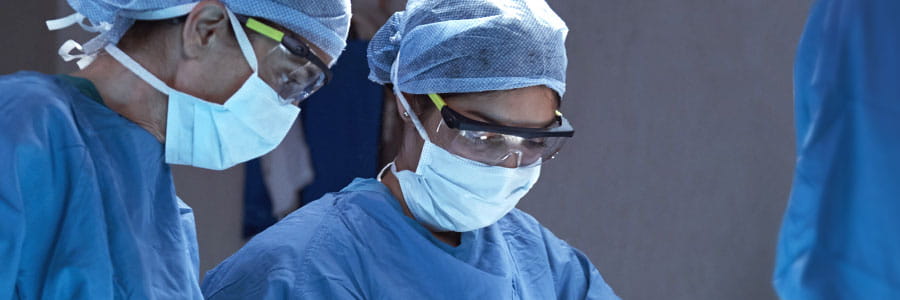
Blending the specialties of neurosurgery and otolaryngology, the surgical team at UPMC was the first in the world to use the nasal passages to reach a variety of deep-seated tumors and lesions that previously required disfiguring and potentially debilitating open surgery. Utilizing endoscopes to visualize the lesions and custom-designed instruments to reach them, UPMC surgeons developed new applications for the Endoscopic Endonasal Approach (EEA), which expanded on this minimally invasive technique originally designed to reach pituitary tumors. The UPMC team has performed more than 1200 EEA procedures, and was the first in the world to perform and publish the following minimally invasive surgical procedures:

First to repair an aneurysm endoscopically through the nose, utilizing the Endoscopic Endonasal Approach.

Even surgeons skilled and experienced at working in small spaces know the formidable challenge of dealing with a rare and large vertebral artery aneurysm—surrounded by vital brainstem anatomy. UPMC surgeons pioneered the use of EEA for an endoscopic transnasal clipping and aneurysmorrhaphy. When an initial endovascular trapping of the aneurysm did not relieve mass effect and continued brainstem compression, the EEA team successfully performed the aneurysmorrhaphy using suction and ultrasonic aspiration—showing how endovascular techniques can treat these difficult lesions.

First to remove a giant teratoma endoscopically through the skull base using a transpalate approach (modified EEA). Patient was a newborn.

Risks posed to a preterm infant born with a giant tumor of the skull base and mouth can be many and immediate—including obstruction of the respiratory and digestive pathways. UPMC’s EEA team responded to such a case removing the “epignathus teratom” using a transpalatal endoscopic endonasal approach. The surgeons found an ample corridor into the ventral skull base without the need for external excisions and/or disruption of bone elements. At the one-year follow up the patient showed no evidence of tumor recurrence and the child remains neurologically intact.

In combination with surgeons in Argentina, first group to consistently perform reconstruction of the skull base using a nasoseptal flap for endonasal vascularized tissue reconstruction.

Experience shows that patients with large dural defects following endonasal skull base surgery face high risk of postoperative cerebrospinal fluid leak. Working with colleagues at the University of Rosario, Argentina, UPMC specialists determined that ensuring adequate blood supply to reconstructed tissue speeds healing. The EEA team developed a versatile and reliable reconstructive technique, meaning sharp drop in the incidence of postoperative cerebrospinal fluid leaks. Forty-three patients undergoing endonasal cranial base surgery were repaired with the technique—only two showed postoperative fluid leaks, both successfully treated with focal fat grafts.

First to remove an arteriovenous malformation endoscopically through the nose, utilizing the Endoscopic Endonasal Approach.

A four-year-old patient with an arteriovenous malformation at the hard to reach skull base faced persistent and life-threatening hemorrhages since the age of two. Doctors first tried open subfrontal surgery, but found minimal access to feeding vessels and did not procede. UPMC’s EEA team felt that they could reach and repair the complex tangle of arteries and vessels. The EEA team successfully performed a two-stage, image-guided, fully endoscopic resection that did not require external incisions. The patient remained free of significant hemorrhages over the past three years.

First to perform surgery for odontoid (2nd vertebra) removal endoscopically through the nose, utilizing the Endoscopic Endonasal Approach.

Surgeons typically approach surgery of lesions located on the upper cervical spine and medulla through a patient’s mouth. UPMC’s EEA team felt that a transnasal path would better serve a 73-year-old woman with a long-standing history of rheumatoid arthritis and progressive cervicomedullary compression. Such a condition can occur as a result of sudden trauma or prolonged degeneration. The EEA team performed a complete resection of the second vertebra (odontoid) using a fully transnasal route.

First to perform a pituitary transposition using EEA to remove retrosellar lesions.

Working surgically around the pituitary gland, a pea-sized organ that helps the body regulate everything from metabolism to thyroid fuction, always presents a challenge. UPMC’s EEA team has demonstrated the viability of taking a fully endoscopic, completely transnasal route to this region. A group of 10 patients, seven men and three women, presented with a variety of conditions (four craniopharyngiomas, four chordomas, and two petroclival meningiomas). All four patients with visual deficits recovered their vision completely with no neurological deterioration.

Contact Us

How can we help you?

Phone Numbers:

1-877-986-9862 (within the U.S.)
For international calls: 01-412-567-7313

Chester Ratcliff

Patient Stories:

Meet Chester Ratcliff

This active grandfather, faced with chronic pain and rapid degeneration, found hope, health, and a renewed life with his grandchildren.

Read Chester's Story »

Meet the Surgeons

Meet the Surgeons:

Our Surgical Team

Our neurosurgeons are among the most experienced in the world in performing minimally invasive brain surgery.

Read about the members of our surgical team »