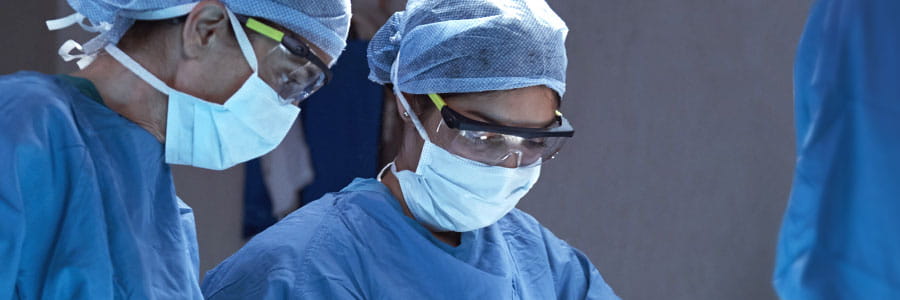
UPMC: Minimally Invasive Brain Surgery

Ranked among America's Best Hospitals 2009 U.S. News & World Report  Honor Roll

Conditions and Treatments

Send to a Friend
Share This Page
Printer-Friendly Page

Arteriovenous Malformation (AVM)/Fistula

Overview

An arteriovenous malformation (AVM) is a congenital defect between the arteries and veins. The condition affects the connection between these blood vessels, and disrupts the flow of blood between them. Although this defect can occur anywhere, AVMs are most common in the brain or spine.

It is common for people not to know that they have an arteriovenous malformation for many years—or even until they reach adulthood. You may not know that you have an arteriovenous malformation in your brain until you experience symptoms such as seizures, headaches, or signs of a brain hemorrhage. A ruptured AVM is a medical emergency.

At UPMC, we are committed to finding the best treatment approach for each patient, maximizing the benefits of surgery while minimizing the risks. When evaluating our patients with this 360° Approach, we look at their conditions from every direction—to find the path that is least disruptive to the patient’s brain, critical nerves, and blood vessels—with the goal of returning to normal functioning. It’s a truly comprehensive, customized approach to care.

Diagnosis

An arteriovenous malformation may not be diagnosed until you experience symptoms, or until the AVM ruptures. Symptoms of an arteriovenous malformation in the brain include:

  • seizures
  • weakness or numbness
  • headaches
  • a pulsing sound in your head

Symptoms of a ruptured arteriovenous malformation are similar to those of a stroke. They include:

  • a sudden, severe headache
  • vision loss
  • difficulty speaking
  • difficulty understanding others

Your physician will order imaging studies to confirm that there is an arteriovenous malformation. These tests may include CT and MRI scans, as well as angiography of the brain.

Treatments

Possible treatments for an arteriovenous malformation include surgery to seal off the AVM, stereotactic radiosurgery to destroy the blood vessels involved in the malformation, and embolization to block blood flow to the AVM. An AVM that has ruptured is a medical emergency and must be dealt with immediately.

At UPMC, we take a 360° Approach to treatment when evaluating each patient—looking at their conditions from every direction—to find the path that is least disruptive to the patient’s brain, critical nerves, and ability to return to normal functioning. Our neurosurgical team may recommend a combination of surgical and nonsurgical approaches to maximize the benefits of surgery while minimizing risks.

Contact Us

How can we help you?

Phone Numbers:

1-877-986-9862 (within the U.S.)
For international calls: 01-412-567-7313