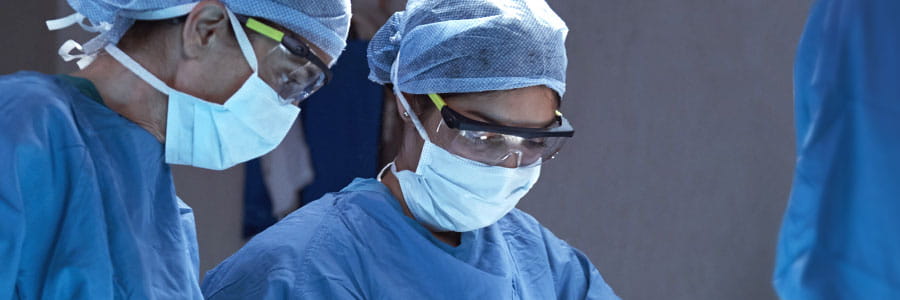
Our 360° Approach is Based on Expertise and Experience
At UPMC, we are committed to finding the best treatment approach
for each patient, maximizing the benefits of surgery while minimizing the risks.
When evaluating our patients, we look at their conditions from every direction —
to find the path that is least disruptive to the patient's brain, critical
nerves, and blood vessels — with the goal of returning to normal functioning.
It's a truly comprehensive, customized approach to care. We call it our 360°
Approach to surgery.
UPMC is one of the few medical centers in the US — and throughout the world —
with expertise in the full array of surgical options for brain tumors and
lesions. Depending on the patient’s condition, treatment options at UPMC may
include pioneering minimally invasive techniques, sophisticated stereotactic
radiosurgery, traditional brain and skull base surgery, and innovative
treatments for cranial nerve disorders.
Our team has pioneered and refined minimally invasive brain surgery techniques, including the
Endoscopic Endonasal Approach
for tumors and lesions in the skull base and upper spine, and the
Neuroendoport®
approach for tumors and lesions within the
substance of the brain and the ventricles (fluid-filled spaces). Since 1987,
UPMC has been a pioneer and world leader in the use of stereotactic
radiosurgery. In addition, our team has unsurpassed clinical experience in
treating cranial nerve disorders dating back more than 25 years.
At UPMC, our team collaborates to seek the best technique — or combination of
techniques — to treat each patient's condition. The following techniques and
technologies may be used individually or in combination:>
Our Treatments
Endoscopic Endonasal Approach (EEA)
EEA is a minimally invasive neurosurgery technique pioneered and refined at UPMC that gives surgeons
access to the base of the skull, central brain, and top of the spine by operating through the nose and
nasal sinuses. Our experienced neurosurgeons partner with expert head and neck surgeons and other
specialists to optimize the procedure.
Neuroendoport® Surgery
Surgeons at UPMC have pioneered a minimally invasive technique for removing deep brain tumors—using an endoscope—through a small clear tube called a Neuroendoport. This tube, or port, allows doctors to access deep-seated tumors through a smaller opening in the lining of the brain than would be used in traditional brain surgery.
Microvascular Decompression for cranial nerve disorders
Microvascular Decompression is a minimally invasive surgical procedure that treats the cause of the
problem, offers the most long-lasting relief, and minimizes risk of postoperative side effects like
numbness.
Microvascular Decompression relieves abnormal compression of a cranial nerve. The surgery consists of a
linear incision behind the ear followed by a craniectomy (bony opening) the size of a silver dollar. Under
the view of a microscope, the surgeons detect the area where the blood vessel is affecting the nerve and
then separate them, leaving a Teflon "pillow" in between.
Each year, more than 500 patients with trigeminal neuralgia are treated at UPMC, including about 100
who undergo microvascular decompression. This high volume of patients has allowed surgeons here to pursue
research aimed at improving treatment effectiveness, making UPMC a world leader in the management of
trigeminal neuralgia.
In the last 25 years, UPMC neurosurgeons have treated more than 20,000 patients with trigeminal
neuralgia. Microvascular decompression provides immediate, complete relief in 82 percent of cases, with
an additional 16 percent achieving partial relief and requiring occasional or low-dose medication. One year
after surgery, 75 percent of our patients continue to enjoy complete pain relief, and an additional 8 percent
have partial relief. Major complications occur in fewer than 5 percent of cases.
In addition, 92 percent of hemifacial spasm patients treated with microvascular decompression
experience complete relief or dramatically improved symptoms.
Other treatments for cranial nerve disorders
Neurosurgeons at UPMC have been pioneering the treatment of cranial nerve disorders for more than
25 years. Their expertise has earned UPMC a worldwide reputation for innovative, top-quality patient
care and cutting-edge research in this evolving field.
Because cranial nerve disorders are often resistant to treatment, UPMC's surgeons incorporate a wide
range of therapies and specialists with the goal of identifying the most effective regimen for each
individual patient. UPMC neurosurgeons have played a major role in the development and continual improvement
of the techniques and instruments used in cranial nerve disorder treatments, including microvascular
decompression, Gamma Knife radiosurgery, and a range of endoscopic procedures. Work with endoscopes has
proven especially beneficial, both in optimizing results and minimizing potential damage to sensitive brain
structures near the affected nerves.
In the last five years, more than 2,000 patients have been treated for cranial nerve disorders at
UPMC, including more than 1,100 patients with trigeminal neuralgia and more than 200 with hemifacial
spasm. In addition to this unsurpassed clinical experience, UPMC is actively involved in a number of
promising research projects, including improved treatment of atypical trigeminal neuralgia, as well as
the effects of Botox on hemifacial spasm.
Awake craniotomy
Brain tumors are often located in regions of the brain that control specific functions such as
movement or speech. To be able to safely operate on tumors in these regions, UPMC neurosurgeons use a
procedure called an awake craniotomy.
During an awake craniotomy, our neurosurgeons use sophisticated brain mapping technology to locate
motor and speech regions prior to tumor removal, so these sensitive areas can be avoided. The patient is
kept awake to continuously monitor these functions during tumor removal in order to protect critical brain
functions, while maximizing the amount of tumor being removed. Patients are often discharged the next day
with few, if any, lingering side effects.
Gamma Knife and CyberKnife stereotactic radiosurgery
Stereotactic radiosurgery is a technique to treat brain disorders that uses hundreds of highly
focused beams of radiation to target tumors and lesions within the brain. The radiation destroys the
tissue that a surgeon would otherwise have removed. This noninvasive treatment does not damage the
healthy brain tissue, critical nerves, or blood vessels that are nearby.
The first Gamma Knife in North America was installed at UPMC in 1987. Today, UPMC is one of the
world's leading centers for Gamma Knife and CyberKnife treatments. UPMC's stereotactic radiosurgery
experts have treated patients with a variety of conditions, including acoustic neuromas, meningiomas,
and arteriovenous malformations. More than 9,000 patients have had Gamma Knife radiosurgery at UPMC,
including 2,500 patients with malignant brain tumors. Recent studies focusing on long-term survival and
return to function noted the positive role of radiosurgery in those patients.
Aneurysm coiling and clipping
Coiling: UPMC has one of the busiest centers in the world for aneurysm coiling, performing more than 180 procedures annually.
An aneurysm coil is a device inserted via catheter to fill in a brain aneurysm—a bulge in a blood vessel. A coil can stop a ruptured
aneurysm from continuing to bleed, or prevent an unruptured aneurysm from bleeding. For certain patients, this minimally invasive
alternative to open surgery produces better outcomes with faster recovery.
A coil implantation system consists of a soft platinum coil soldered to a stainless steel delivery wire. To treat an aneurysm, the
surgeon first places a microcatheter inside the aneurysm. Once the catheter is properly positioned, a coil is navigated through the
catheter and into the aneurysm.
When the coil is properly positioned, a mild electrical current (about 1/10,000th of the current required to run a hair dryer from
a home outlet) is applied to the delivery wire. The current separates the stainless steel delivery wire near the platinum coil. Then,
the delivery wire is removed, leaving the coil in place. This process is repeated until the aneurysm is densely packed with coils.
Clipping: At UPMC, Microsurgical clipping for the treatment of aneurysms has demonstrated excellent durability and results. The procedure
consists of a making a small opening in the skull and using a specialized microscope to isolate the blood vessel that feeds the aneurysm. The
neurosurgeon then places a small metal, clothespin-like clip on the aneurysm’s neck, halting its blood supply. The microscope is a key component
of the procedure, as it can confirm the appropriate blow flow inside the arteries, as well as determine the lack of blood flow entering the
aneurysm after it is clipped. The clip remains in the patient and prevents future bleeding or rupture.
Microsurgical clipping has seen many modern advancements, such as advanced, high-tech microscopes, live-imaging feeds of blood vessels, as
well as a broad array of clip configurations, that have allowed for improved patient outcomes at UPMC. The neurosurgical team also utilizes
advanced monitoring modalities that allow them to detect any damage that might occur and to correct the problem before any permanent damage occurs.
AVM treatment and management
UPMC is one of the nation’s largest and most experienced centers for the treatment of arteriovenous malformations (AVMs), abnormal, berry-like
patches of blood vessels in the brain. Three common procedures performed at UPMC for the treatment of AVMs include:
Microsurgical Resection: This procedure involves delicately separating the AVM from the surrounding tissue. Using a microscope, the neurosurgeon
obliterates the blood supply to the AVM and removes it. An advantage of this procedure is that the AVM is immediately corrected following a successful surgery.
Embolization: Embolization is a non-surgical, minimally invasive procedure that involves the threading of a small catheter or tube through a blood vessel in the groin,
which is then navigated to blood vessels in the brain to create an emboli or block blood flow. Glue, metal small coils, or detachable silicon balloons are guided through
the arteries to block the abnormal blood flow to the AVM.
Gamma Knife Radiosurgery: Using hundreds of highly focused beams of radiation, UPMC neurosurgeons can directly target and treat AVMs. This procedure is highly effective for
treating AVMs located in areas of the brain that are difficult to access through other techniques. Over time, the targeted radiation damages the AVM tissue, causing the blood
vessels to seal. This noninvasive treatment has a low risk of damage to healthy brain tissue, critical nerves, or nearby blood vessels.
Carotid angioplasty and stenting
In carotid angioplasty, a surgeon uses a microcatheter—a long tube tipped with miniature
instruments—to reopen a blockage of the carotid artery in the neck. Such blockages can cause a
devastating stroke or increase the risk of stroke, because the carotid artery supplies the brain with
much of its blood supply.
Once the catheter reaches the site of the blockage, a miniature balloon reopens the carotid artery.
The doctor also may insert a stent—a kind of meshwork collar—to help hold the artery open.
Angioplasty also can be performed on blockages in the vertebral artery that threaten blood supply to
the spinal cord.
Percutaneous Transluminal Arterial Angioplasty (PTA) and stenting
In percutaneous transluminal angioplasty (PTA), a surgeon threads a microcatheter—a long tube
tipped with miniature instruments—into an artery to reopen it, usually with a tiny balloon. The
surgeon may also use the catheter to place a tiny meshwork stent in the reopened artery to help keep it open.
PTA can be used to reopen blockages in intracranial arteries located between the brain and its middle
membrane. These blockages are particularly dangerous because they rupture easily. PTA can also be used to
reopen the carotid artery.
Tumor embolization
Embolization is a non-surgical minimally invasive procedure that involves the threading of a small
catheter or tube through a blood vessel in the groin, which is then navigated to blood vessels in the
brain to create an emboli or block blood flow. Small coils or detachable silicon balloons are guided
through the arteries to stop the blood flow to an area of the brain or body in order to shrink tumors,
prevent blood clots, or stop an aneurysm.
Traditional surgical approaches
In addition to minimally invasive approaches, UPMC's neurosurgical team is trained and experienced in
all traditional approaches to the brain, so they fully understand all of the options available to them.
This expertise allows our neurosurgeons to develop the best treatment plan for each patient, utilizing the
technique or combination of techniques that offer the best opportunity for returning the patient to normal life.